Walk into any hardware store in Toronto in November and you’ll see the same scene: someone standing in the furnace filter aisle, holding their phone, staring at a wall of white rectangles, trying to remember what size their furnace takes. Then they guess. Half the time they guess wrong, drive home, and find out the filter doesn’t fit — or worse, it fits badly enough that air sneaks around it for the next three months.
Here’s the thing nobody tells you: the furnace filter is the cheapest part of your whole heating system, and also the one that causes the most trouble when it’s wrong. A ten-dollar filter, ignored, can shut your furnace down on the coldest night of the year. A filter that’s too restrictive can starve your furnace of air and shorten its life.
This guide covers it all in plain language: how to find your size, what those MERV numbers actually mean, how often to change it in a real Toronto winter, and how to swap it yourself in about five minutes.
Finding Your Filter Size (It’s Printed Right on the Frame)
Every disposable furnace filter has its size printed on the cardboard frame — three numbers, something like 16x25x1. That’s length by width by thickness, in inches. The most common size in Toronto homes is 16x25x1, but 20x25x1, 16x20x1, and 20x20x1 are all common too, and plenty of houses have something else entirely.
The easiest way to get it right: pull your current filter out and read the frame. Don’t measure the slot and don’t guess from memory. If the old filter is gone, or it’s so grey you can’t read it, check the sticker on the furnace itself — the manufacturer usually lists the filter size there — or check your furnace manual. Still stuck? Take a photo of the filter slot and the furnace model number, and any HVAC tech can tell you the size in about ten seconds.
One warning that matters: the size on the frame is the nominal size, and the actual filter is usually a fraction of an inch smaller so it slides in. That’s normal. What isn’t normal is forcing a filter that’s clearly too big, or dropping in one that’s an inch short on a side — air takes the path of least resistance, and a gap around the filter lets unfiltered air straight through. Snug is the goal.
MERV Ratings, Explained Without the Jargon
MERV stands for Minimum Efficiency Reporting Value. It’s a scale from 1 to 16 that tells you how small a particle the filter can catch. Higher number, finer filtration. That’s the whole idea — but the part people miss is that higher is not automatically better for your furnace.
Here’s how it breaks down for a normal Toronto home. MERV 8 catches dust, pollen, and lint — the basics — and it’s what most builders install. MERV 11 catches smaller stuff, including pet dander and some mould spores, and it’s a solid step up for most households. MERV 13 catches finer particles still, including many bacteria-sized particles and smoke, and it’s where a lot of people with allergies or asthma land. Above MERV 13, you’re into hospital and commercial territory, and most residential furnaces aren’t designed for it.
The catch is airflow. A finer filter is a denser filter, and denser means harder for your furnace’s blower to push air through. Put a MERV 13 in a system designed for MERV 8 and an older blower may struggle — airflow drops, the furnace runs longer, and in the worst case the heat exchanger overheats and the safety switch trips. That’s not a theory; we see it every winter. Our rule of thumb: MERV 8 to 11 suits most Toronto homes, MERV 13 if someone in the house has real allergies or asthma and your system can handle it — and if you’re not sure your system can handle it, ask a tech before you upgrade, not after your furnace starts short-cycling.
How Often to Change It in a Toronto Winter
The box says every 90 days. In Toronto, in January, when your furnace is running most of the day, that number is optimistic. Our honest answer: check it monthly during heating season, and expect to change a standard 1-inch filter every 1 to 3 months.
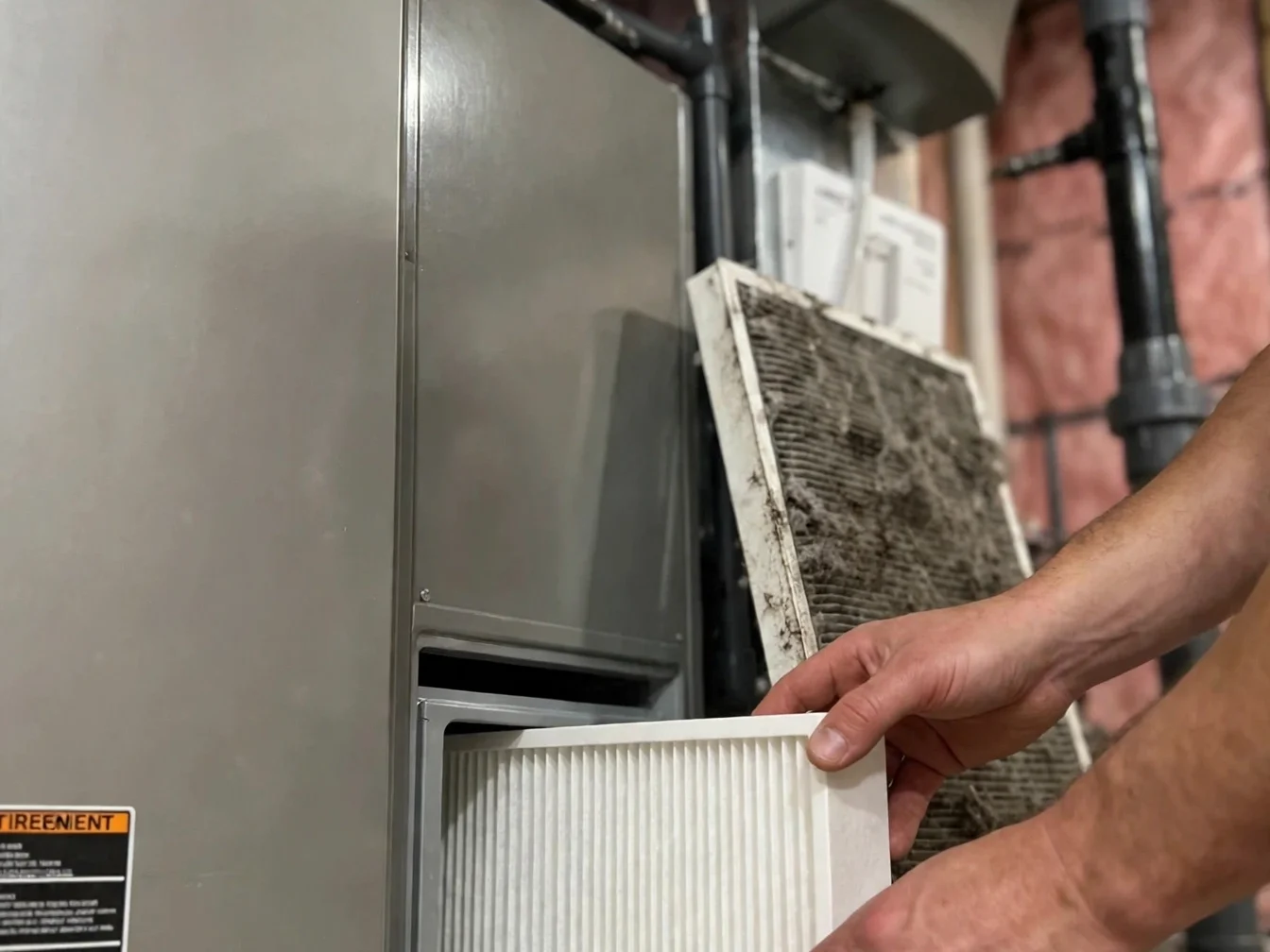
What pushes you toward the short end? Pets, especially dogs and cats that shed. Renovations or construction dust. A house near a busy road. Someone in the house who smokes, or a wood fireplace you use often. Any of those, and a filter can be done in a month. A quiet house with no pets and no renovation dust can stretch to three months, but even then, don’t just trust the calendar — pull it out and look at it. Hold it up to a light. If you can’t see light through it, it’s done, no matter what the calendar says.
Thicker media filters last longer — typically 6 to 12 months — because they have so much more surface area to load up with dust. Same rule applies though: check them on a schedule, don’t just forget about them for a year and hope.
What a Clogged Filter Actually Does to Your Furnace
A clogged filter doesn’t just make your air a bit dustier. It starves the furnace of airflow, and that sets off a chain reaction. The heat exchanger gets too hot because the heat has nowhere to go. The high-limit safety switch trips and kills the burners. The fan keeps running, pushing unheated air through your ducts. From upstairs, it feels like the furnace is blowing cold air — and in a very real sense, it is. We wrote a full guide on why a furnace blows cold air, and a dirty filter is the single most common cause on that list.
Left long enough, restricted airflow does worse than cause a cold night. Repeated overheating stresses the heat exchanger, and a cracked heat exchanger is the repair that ends furnaces. A ten-dollar filter, ignored for a year, can genuinely contribute to a five-figure replacement. That’s not a scare line — it’s the most expensive cheap part in your house.
How to Change It Yourself in Five Minutes
You don’t need tools, and you don’t need to be handy. Here’s the whole job:
First, turn the thermostat down or switch the system off — you don’t want the furnace firing up while the filter slot is open. Find the filter slot: it’s usually at the bottom or side of the furnace cabinet, where the big return-air duct connects. There’s often a small access door or a slot with a cover. Slide the old filter out and note the arrow printed on its frame — that arrow shows airflow direction, and it points toward the furnace, not away from it.
Slide the new filter in with its arrow pointing the same way, toward the furnace. Push it all the way in so it sits flat. Close the access door. Turn the thermostat back up. That’s it. Five minutes, no tools, and you’ve just done the single most useful piece of furnace maintenance a homeowner can do.
Two mistakes to avoid: putting the filter in backwards (the arrow matters — a backwards filter still filters, but not as well, and it can collapse or whistle), and leaving the slot open or the door off because the new filter “didn’t quite fit.” If it doesn’t fit, it’s the wrong size. Get the right one. An open slot pulls unfiltered basement air straight into your system, which defeats the entire purpose.
When to Call a Technician Instead
Changing a filter is a homeowner job. But if a fresh filter doesn’t fix what you’re feeling — the air is still cold, the furnace still short-cycles, or it keeps shutting down — stop swapping filters and call someone. The problem is further down the list: a failing blower motor, a dirty flame sensor, a faulty limit switch, or something else that needs tools and training. Our team handles emergency furnace repair in Toronto around the clock, and a filter problem that turns out to be something else is a diagnosis we’d rather do early, while it’s still cheap.
Frequently Asked Questions
What size furnace filter do I need?
Read the size printed on your current filter’s frame — three numbers like 16x25x1. If the old filter is gone, check the sticker on the furnace or the manual. 16x25x1 is the most common size in Toronto, but don’t guess: a filter that’s too small lets unfiltered air bypass it, and one that’s too big won’t fit at all.
Is a higher MERV filter better?
Not automatically. Higher MERV catches finer particles, but it also restricts airflow more. MERV 8 to 11 suits most Toronto homes; MERV 13 is good for allergies or asthma if your system can handle it. Putting a high-MERV filter in a system that wasn’t designed for it can reduce airflow enough to overheat the furnace — ask a tech before upgrading.
How often should I change my furnace filter in winter?
Check it monthly during heating season and expect to change a standard 1-inch filter every 1 to 3 months. Homes with pets, renovation dust, or a smoker in the house sit at the short end. Thicker 4-inch or 5-inch media filters last 6 to 12 months. When in doubt, hold it up to a light — if you can’t see light through it, change it.
Can a dirty filter really break my furnace?
Yes. A clogged filter starves the furnace of airflow, the heat exchanger overheats, the safety switch trips the burners, and you get cold air from the vents. Repeated overheating stresses the heat exchanger, and that’s the damage that turns a small problem into a furnace replacement. It’s the most common preventable cause of no-heat calls we see.
Does the arrow on the filter matter?
Yes. The arrow shows airflow direction and must point toward the furnace. A backwards filter still catches some dust, but it doesn’t work as designed and can collapse or whistle. When you slide the new one in, match the direction of the old one.
The Ten-Dollar Habit That Saves Your Winter
Furnace filters are boring. Nobody brags about changing one. But in a Toronto winter, that boring ten-dollar rectangle is the difference between a warm house and a midnight emergency call — and between a furnace that lasts twenty years and one that dies early from overheating. Buy the right size, pick a sensible MERV, check it monthly from October to April, and change it when it looks done.
If your furnace is acting up even with a fresh filter, or you’re not sure your system can handle a higher-MERV filter, call EcoCare Home Comfort at (888) 929-2270. We’re available 24/7 across Toronto and the GTA, and we’ll tell you straight what your system needs — no upsell, no jargon, just the right filter and a furnace that runs the way it should.