It’s late, it’s dropping past minus fifteen outside, and your house has that quiet, getting-colder feel. The thermostat says it’s calling for heat. The furnace says nothing — no hum, no fan, just silence from the basement.
Before you pay for an after-hours service call, take ten minutes. A big share of the “dead furnace” calls we run in Toronto turn out to be something small — a switch, a battery, a filter, a snowdrift. Run these seven checks in order. Two of them fix it for free more often than you’d think.
1. Check the Thermostat First (Yes, Really)
Start upstairs, not in the basement. Half the time the furnace is fine — it’s not being told to run.
Make sure it’s set to HEAT, not COOL or OFF — thermostats get bumped during cleaning, and kids love pressing buttons. Then set it at least 3 degrees above room temperature; a one-degree nudge isn’t always enough to make a system fire.
Screen completely blank? The batteries are probably dead. Most thermostats take two AA or AAA — pull the unit straight off its wall plate, swap them, click it back on. A dying battery can also leave the screen lit but too weak to signal the furnace.
After changing anything, wait five full minutes — furnaces have built-in delays, and a system that looks dead is sometimes just counting down.
2. Find the Furnace Power Switch and the Breaker
Every furnace in Ontario has a shut-off switch that looks exactly like a regular light switch — because that’s basically what it is. Look on the wall near the furnace, at the top of the basement stairs, or on a ceiling joist by the unit. It gets flipped by accident constantly: someone storing boxes, a guest hunting for a light, a kid exploring.
Find it and make sure it’s ON — if it was off, give it a few minutes and listen for the start-up sequence.
Still nothing? Check the electrical panel for the breaker labelled “furnace” or “heating.” A tripped breaker sits in the middle, not fully on or off. Push it OFF, then back ON. If it trips again, stop — that’s an electrical problem, not a DIY one.
3. Pull the Filter — A Clogged One Shuts Furnaces Down
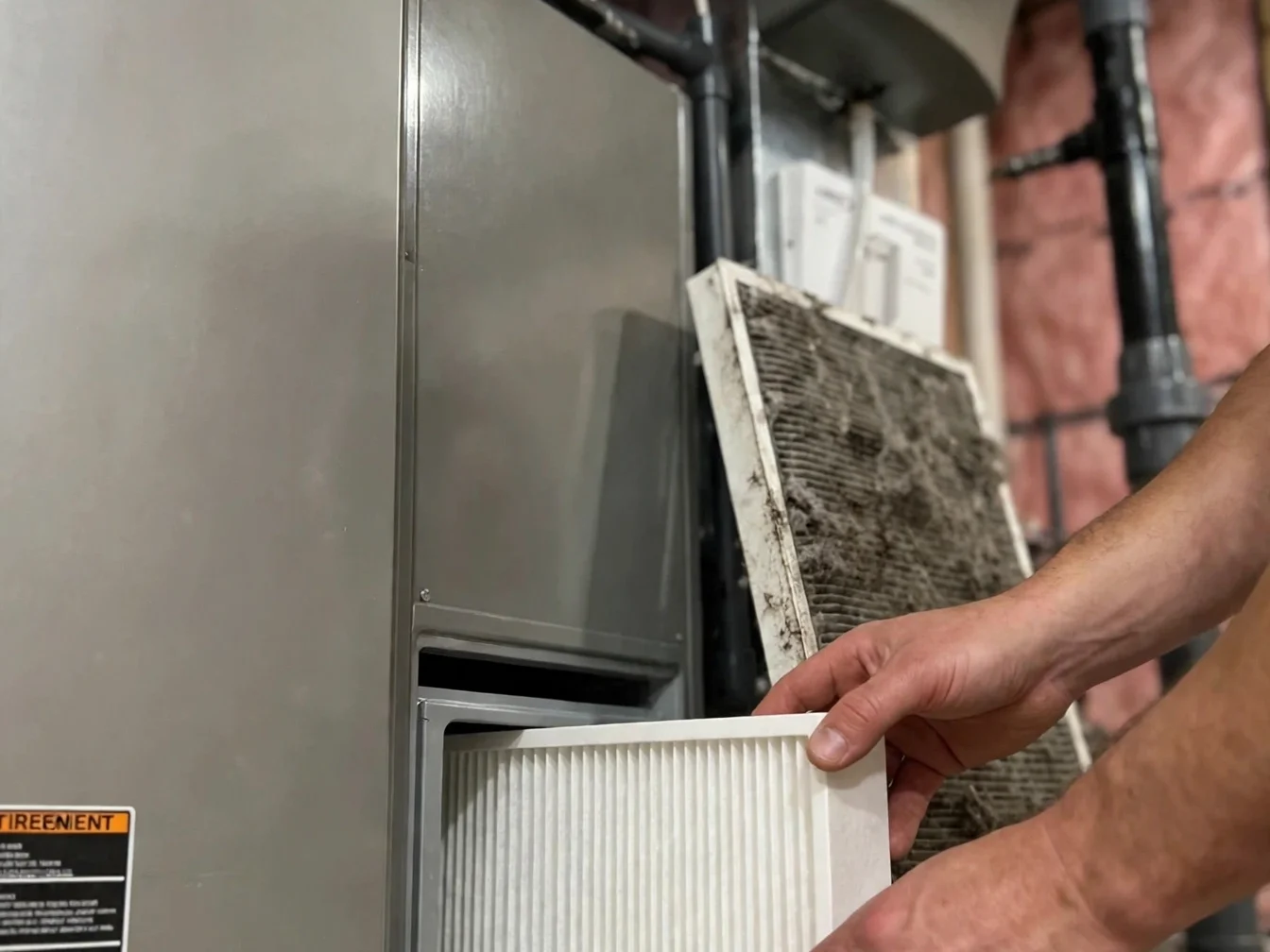
Your furnace protects itself. When the filter gets packed with dust and pet hair, airflow drops, the furnace overheats, and a safety switch — the high-limit switch — kills the burner. From upstairs, it just looks like a furnace that quit.
The filter slot is usually at the bottom or side of the cabinet, where the big return-air duct connects. Slide the filter out and hold it up to a light. Can’t see light through it? It’s done. The size is printed on the cardboard frame (16x25x1 is common).
No spare handy? You can run it briefly filter-free to confirm the diagnosis — but install a new one the next day; running without one drags dust straight into the blower. Give the fresh filter a few minutes — some systems need the power cycled at the switch to clear the lockout.
4. Older Furnace? Check the Pilot Light and Gas Valve
If your furnace is from the 1990s or earlier, it may have a standing pilot — a small blue flame that burns all the time. Look through the viewing window near the burners. No flame? The pilot’s out, and the furnace won’t fire.
Also check the gas supply: a shut-off valve on the pipe near the furnace (handle parallel with the pipe means open) and a knob on the furnace marked OFF / PILOT / ON. Turned off for summer work and forgotten? There’s your answer.
Relighting a pilot is a job plenty of homeowners do safely — follow the exact steps on the sticker on the furnace panel, word for word. Two hard rules: if you smell gas, stop and read the safety box below. And if the pilot lights but won’t stay lit, don’t keep retrying — that’s usually a failing thermocouple, and it needs a technician.
Furnace under about 20 years old? It almost certainly has electronic ignition, not a pilot — nothing to relight. Skip ahead.
5. Check the Condensate Drain (High-Efficiency Furnaces)
Got white PVC pipes venting through the side wall? That’s a high-efficiency furnace, and it makes water as it runs. It drains through a small plastic trap and clear tube, often into a condensate pump beside the furnace.
When that drain clogs with slime and sediment, a float switch shuts the furnace down so water can’t back up into the unit. From upstairs: dead furnace. From the basement: often a ten-minute fix. Check the pump reservoir — if it’s full and the pump isn’t running, make sure it’s plugged in (yes, it happens). A clogged trap can often be cleared with a wet/dry vacuum at the drain outlet, and once the water level drops, the furnace frequently restarts on its own.
6. Go Outside: Snow and Ice Block the Intake and Exhaust Pipes
This is the Toronto one. American advice sites don’t lead with it, but after a real storm, with drifts whipped against the side of the house, it’s one of the top reasons a furnace quits here.
Those white PVC pipes stick out of your side wall, a foot or two off the ground: one brings air in, one pushes exhaust out. When snow buries them, or exhaust moisture builds an ice plug in the openings, the furnace can’t prove safe airflow through its pressure switch and locks out. Some try three times, then give up for hours.
Take a shovel, not just a look. Clear the snow back a good metre around both pipes, and clear ice from the openings gently, by hand. Never jam a screwdriver or stick in there — you can push debris deeper or crack a fitting. Plow windrows cause this more than the snowfall itself, so check after every big storm.
7. Read the Error Code — Your Furnace Is Trying to Tell You Something
If the furnace has power but won’t complete a start-up, don’t guess — ask it. On the lower door of most furnaces there’s a small round sight glass, about the size of a loonie. Look through it: an LED is blinking in a pattern — three short flashes, a pause, then three again.
Count the flashes, then check the chart — usually a sticker inside the blower door panel. Common ones: pressure switch problem (re-check those vents), flame sensor fault, ignition failure, high-limit trip (re-check that filter).
Write the code down before calling anyone. “It’s blinking three times” cuts real time off a diagnosis.
Still Nothing? What It Probably Is
If you’ve run all seven checks and it’s still dead, it’s likely a failed part — and this is where the DIY part honestly ends:
- Hot surface ignitor. The ceramic piece that glows orange to light the burners — the single most common no-heat failure. It cracks with age. Typical Toronto replacement: $150–$300 installed.
- Flame sensor. A thin metal rod that confirms the flame lit. Dirty or worn, it lets the furnace light for a few seconds, then shuts it down, over and over. Cleaning sometimes fixes it; replacement runs about the same as an ignitor.
- Control board. The furnace’s brain. Boards fail after power surges and old age. Typical replacement: $400–$800, depending on the model.
- Inducer or blower motor. Humming, grinding, or silence where a motor should spin points here. Costs vary widely.
Those are typical ranges, not quotes — the model and the failed part decide the real number. Our furnace services cover everything from these repairs to full replacements.
Stop: Two Safety Rules That Outrank Everything Above
If you smell gas — that rotten-egg odour — don’t touch light switches, don’t use your phone inside, and don’t try to relight anything. Get everyone out, then from outside or a neighbour’s home call 911 or the Enbridge Gas emergency line at 1-866-763-5427 (24 hours, every day). Gas leaks are not a troubleshooting project.
If your carbon monoxide alarm goes off, same answer: everyone out, including pets, and call 911 from outside. Don’t go back in to grab things. CO is odourless — the alarm is the only warning you get.
Frequently Asked Questions
Why did my furnace stop working suddenly?
Most sudden shutdowns aren’t a major breakdown — they’re a safety system doing its job. A clogged filter trips the high-limit switch, a blocked vent trips the pressure switch, a full condensate drain trips the float switch. Annoying at midnight, but far better than the alternative.
How do I reset my furnace?
Turn the thermostat down, flip the power switch off, and wait 30 seconds. Switch it back on, then turn the thermostat up. That clears most temporary lockouts. But if it locks out again after one or two tries, stop — repeated lockouts mean something is genuinely wrong, and forcing it can make things worse.
Is it worth repairing a 15-year-old furnace?
Depends on the bill. A $200 ignitor on a well-maintained 15-year-old furnace? Usually yes. A $700 control board on a unit that’s already had two repairs this winter? That’s money toward a replacement. A rough rule techs use: if the repair costs more than half the furnace’s remaining value, start comparing. Our furnace installation cost guide breaks down what a new system runs in Toronto — do the math with real numbers.
How much is an emergency furnace call in Toronto?
Expect a diagnostic fee in the $100–$200 range, with after-hours and weekend calls at the higher end — typical across the GTA, not just us. The repair itself is extra, and any company you call should quote it first, so you decide with the full price in front of you.
How long can a house go without heat in winter before pipes freeze?
Less time than most people think. Around minus 15 to minus 20 outside, an unheated Toronto house can start putting pipes at risk within roughly 6 to 12 hours — pipes on exterior walls go first. While you wait, let faucets drip slightly, open cabinet doors under sinks, and keep interior doors open so the remaining warmth circulates. Don’t treat a dead furnace in a cold snap as a “call Monday” problem.
Run the Checks. Still Cold? Call Us.
If you worked through the list and your furnace is still silent — or it starts, shuts down, and keeps cycling — it’s time for a technician. EcoCare Home Comfort provides emergency furnace repair in Toronto and across the GTA, 24 hours a day, 7 days a week.
Call (888) 929-2270 for a free quote. Tell us the error code, and we’ll take it from there.