Your furnace quit on a cold night. Before you call anyone, there’s one question sitting in the back of your mind, louder than all the others: how much is this going to cost me? And the frustrating part is that nobody will give you a straight answer over the phone, because the honest answer is that it depends on what’s actually broken — and nobody knows that until someone looks at it.
This guide gives you the next best thing to a quote: the typical Toronto price ranges for the repairs we actually do, what pushes a bill up or down, how to tell a fair price from a bad one, and the point where repairing stops making financial sense. These are typical ranges, not quotes — your model and the failed part decide the real number — but after reading this, no contractor will be able to surprise you.
The Diagnostic Fee Comes First
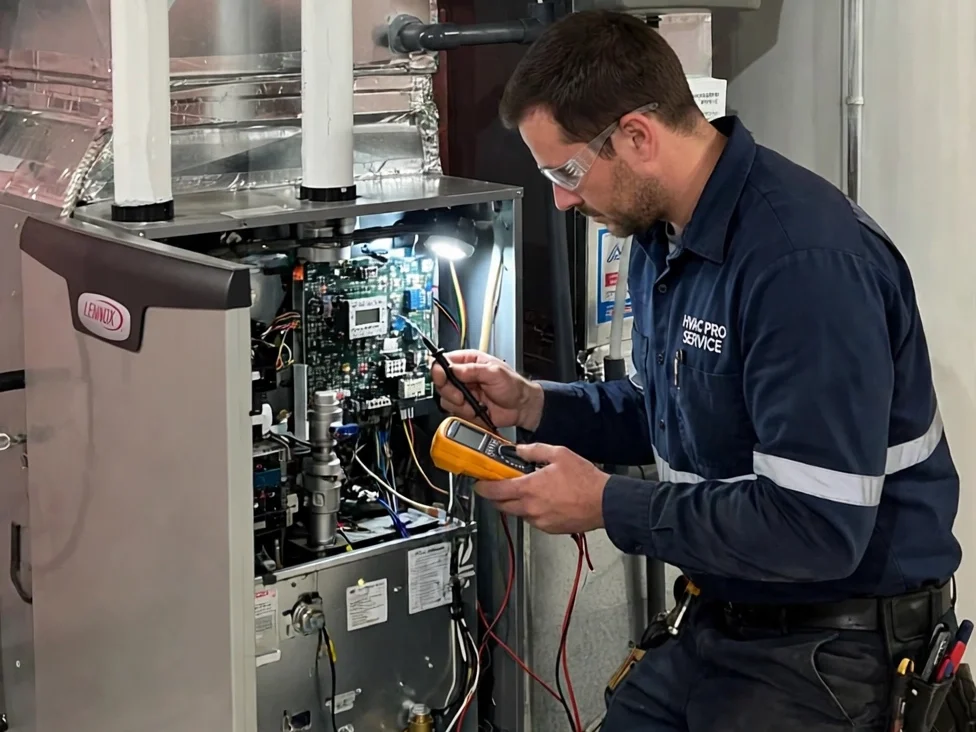
Almost every furnace repair in Toronto starts with a diagnostic fee, typically $100 to $200. That covers a technician coming to your home, finding the actual fault, and telling you what it will cost to fix before any work starts. After-hours and weekend calls sit at the higher end of that range — that’s standard across the GTA, not just us — because you’re paying for someone to come out at 11 p.m. on a Saturday in January.
Here’s what the fee should buy you: a real diagnosis, not a guess, and a firm price for the repair before work begins. Any company that won’t quote the repair before starting it is a company you should think twice about. The diagnostic fee is also, in most cases, applied to the repair if you go ahead — ask about that when you call, because it changes the math. And if the technician finds the problem in five minutes and it’s something simple, a good company will tell you that too, not stretch the visit into a bigger bill.
What the Common Repairs Actually Cost
Most common furnace repairs in Toronto land between $150 and $900, depending on the part. That range covers the vast majority of no-heat calls, and here’s how it breaks down.
At the low end sits the flame sensor. It’s a thin metal rod that confirms the flame is lit, and it gets coated in oxidation over time until the furnace lights for a few seconds and shuts down, over and over. Cleaning it is a quick job and often included in a standard service call — it’s one of the cheapest professional fixes there is. If cleaning doesn’t do it, replacement runs about the same territory as an ignitor.
The hot surface ignitor is the single most common no-heat failure we see. It’s the ceramic piece that glows orange to light the burners, and it cracks with age. A typical Toronto replacement runs $150 to $300 installed. It’s a straightforward job — the part itself isn’t expensive, and the labour is under an hour — but it’s the part that fails most often, which is why it tops the list.
Further up the range is the control board — the furnace’s brain. Boards fail after power surges and old age, and a typical replacement runs $400 to $800 depending on the model. Some boards are proprietary to a brand or a model year, and that availability is what moves the price. If your board is obsolete and has to be sourced or substituted, expect the higher end and a longer wait.
Inducer and blower motors sit in the same upper territory, and their cost varies widely — a weak capacitor is sometimes the real culprit and a much cheaper fix, but a dead motor is a significant repair, and the motor’s size and brand decide the number. A good technician will check the capacitor first before quoting you a motor, and you should be suspicious of anyone who doesn’t.
Then there’s the exception that changes everything: a cracked heat exchanger. The heat exchanger is the metal chamber separating combustion gases from the air you breathe, and years of heating cycles can crack it. On an older furnace, replacement almost never makes financial sense — the part is expensive, the labour is extensive, and you’re putting major money into a unit that’s already near the end of its life. A cracked heat exchanger usually means replacing the furnace, and that’s a different conversation entirely, which is why knowing what furnace installation costs in Toronto matters before you decide anything.
What Pushes Your Bill Up (or Down)
Four things decide where in the range you land. The part itself is the biggest one — a sensor costs a fraction of a control board, and proprietary brand parts cost more than universal ones. The model and age of your furnace matter too: a common Lennox or Carrier from the last decade has parts on every supplier’s shelf, while a twenty-year-old unit from a brand that left the Canadian market can mean special orders and waiting.
Timing is the third factor. After-hours, weekend, and holiday calls cost more, because you’re paying for emergency availability. If the furnace quit at 2 p.m. on a Tuesday, you’ll pay less than if it quit at 2 a.m. on a Sunday — same repair, different clock. The fourth factor is access and condition: a furnace buried behind stored boxes in a crawl space takes longer to work on than one standing clear in an open basement, and a unit that’s been neglected for years often hides a second problem behind the first one.
What should not push your bill up: vague “system rejuvenation” add-ons, parts replaced “just in case,” or a technician who finds three problems when you called about one. A second opinion is free to ask for and cheap insurance on any bill over $500. If something feels off, get it.
Repair or Replace? The Rule Techs Actually Use
Here’s the rule of thumb most technicians use, and it’s a good one: if the repair costs more than half the furnace’s remaining value, start comparing replacement. A $200 ignitor on a well-maintained 15-year-old furnace? Usually yes, fix it. A $700 control board on a unit that’s already had two repairs this winter and is pushing twenty years? That’s money toward a replacement, and a replacement comes with a warranty, better efficiency, and no more midnight surprises.
Age is the other half of the equation. Furnaces typically last 15 to 20 years. Under 10 years, repair almost always wins. Over 20, replacement usually wins, because you’re paying to extend a system that’s already past its design life. Between 15 and 20, it depends on the bill, the repair history, and how efficient the old unit is — a new high-efficiency furnace can cut gas bills enough that the replacement starts paying for itself, especially in a Toronto winter where the furnace runs for months.
If replacement is where you land, do the math with real numbers before you commit. Our furnace installation cost guide breaks down what a new system runs in Toronto, and our furnace services cover everything from these repairs to full replacements — but get the comparison in writing either way, from whoever you call.
Red Flags: How to Spot a Bad Quote
Most HVAC companies in Toronto are honest. The ones that aren’t tend to show the same signs. No price before work starts — walk away. Pressure to decide on the spot, especially “this price is only good tonight” — walk away. A diagnosis that skips straight to the most expensive part without checking the cheap ones first — a flame sensor or capacitor should be ruled out before a control board or motor is quoted. And a quote that’s dramatically lower than everyone else’s, with no explanation of what’s included — that’s usually a diagnostic fee that isn’t a diagnostic, or a part that isn’t the part you need.
The best protection is simple: ask for the failed part to be shown to you, ask for the repair price in writing before work starts, and ask what the warranty is on parts and labour. A company that answers all three without hesitation is a company you can trust with the next repair too.
Frequently Asked Questions
How much is a furnace repair call in Toronto?
Expect a diagnostic fee in the $100 to $200 range, with after-hours and weekend calls at the higher end. Most common repairs then land between $150 and $900 depending on the part — an ignitor typically $150 to $300 installed, a control board $400 to $800. These are typical ranges, not quotes; your model and the failed part decide the real number.
What is the most common furnace repair?
The hot surface ignitor — the ceramic piece that glows orange to light the burners. It cracks with age and is the single most common no-heat failure. A dirty flame sensor is a close second, and it’s often the cheapest fix of all, since cleaning it is a five-minute job.
Is it worth repairing a 15-year-old furnace?
Depends on the bill. A $200 ignitor on a well-maintained 15-year-old furnace is usually yes. A $700 control board on a unit that’s already had two repairs this winter is money toward a replacement. The rule techs use: if the repair costs more than half the furnace’s remaining value, start comparing replacement.
Why does an after-hours repair cost more?
You’re paying for emergency availability — a technician on call at night, on weekends, or on holidays. The repair itself costs the same; the timing is what moves the price. If the furnace can safely wait until morning, a daytime call will be cheaper — but in a Toronto cold snap, don’t let pipes freeze to save a call-out fee.
Should I get a second opinion on an expensive repair?
Yes, on anything over $500, and especially on anything that involves replacing the furnace. A second opinion costs a diagnostic fee and can save you thousands if the first diagnosis was wrong or the “repair” was really a sales pitch for a new system.
Know the Number Before Anyone Starts Work
Furnace repairs aren’t mysterious, and they shouldn’t feel like a gamble. Most of them fall in a known range, the diagnostic should come with a firm price before work starts, and the repair-or-replace decision has a rule you can apply yourself. The homeowners who get burned are the ones who approve work without a number in front of them.
If your furnace has quit, or it’s making a noise it didn’t make last winter, call EcoCare Home Comfort at (888) 929-2270. We provide emergency furnace repair in Toronto and across the GTA, 24 hours a day, 7 days a week. We’ll diagnose it properly, quote the repair in writing before we touch a tool, and tell you honestly whether fixing it or replacing it is the smarter spend.